
Introduction
Choosing the right walking cane isn't just about style—it's about safety, comfort, and maximizing your mobility. The single most important factor? Getting the height exactly right. An improperly sized cane can cause shoulder strain, wrist fatigue, poor posture, and unsteady footing. Whether you're selecting your first walking cane or upgrading to a premium model, this comprehensive guide will help you find your perfect fit.
Why Cane Height Matters More Than You Think
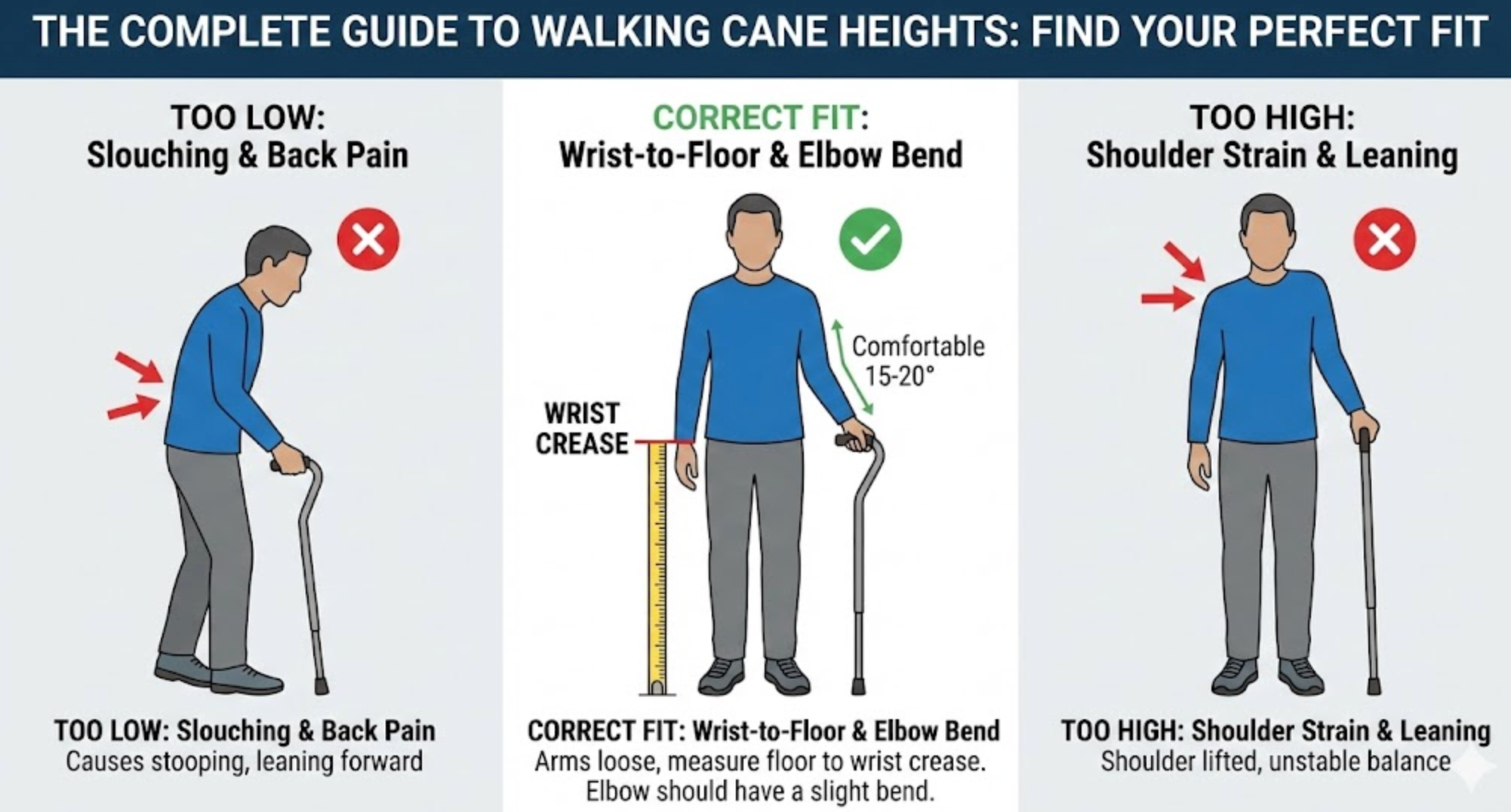
Your walking cane should be an extension of your arm, providing support without forcing your body into awkward positions. When properly sized:
- Your elbow bends at a comfortable 15-20 degree angle.
- Your wrist aligns naturally with the top of your hip bone.
- Your shoulder remains level, not hunched or raised.
- Your weight is evenly distributed throughout the cane.
- You maintain proper upright posture while walking.
An incorrect height forces compensation. A cane that's too tall pushes your shoulder up and creates neck tension. A cane that's too short makes you lean forward, stressing your lower back and reducing stability. After years of fitting customers at Canes Galore, we've seen how a two-inch difference can transform someone's walking experience.
The Standard Measurement Method
Here's the professional approach we recommend:
- Wear your normal walking shoes. Heel height affects the measurement.
- Stand naturally upright with your arms relaxed at your sides.
- Locate your wrist crease—the point where your wrist meets your hand.
- Measure from the floor to your wrist crease. This is your ideal cane height.
For most adults, this measurement falls between 30 and 38 inches. Taller individuals may need 38-42-inch canes, while petite users often need 28-32 inches.
The Quick Wall Test
No measuring tape? Try this simple method:
Stand with your back against a wall, arms hanging naturally. Have someone place a pencil mark on the wall at your wrist crease level. Measure from the floor to the mark. This gives you an accurate starting point.
Walking Cane Height Chart
Use this chart to cross-check the number you just measured. It follows the half-your-height rule, which lands within an inch of the wrist-crease measurement for most people. All heights assume you are wearing your normal walking shoes.
| Your height (with shoes) | Recommended cane height | Typical fit |
|---|---|---|
| 4'10" (58") | 29" | Adjustable, set to shortest |
| 5'0" (60") | 30" | Adjustable |
| 5'2" (62") | 31" | Adjustable |
| 5'4" (64") | 32" | Adjustable or cut-to-size |
| 5'6" (66") | 33" | Adjustable or cut-to-size |
| 5'8" (68") | 34" | Standard 36" wood cane, cut to size |
| 5'10" (70") | 35" | Standard 36" wood cane, cut to size |
| 6'0" (72") | 36" | Standard 36" wood cane, no cutting |
| 6'2" (74") | 37" | Extra long, 36"+ |
| 6'4" (76") | 38" | Extra long, 36"+ |
| 6'6" (78") | 39" | Extra long, 36"+ |
In the 29–33" range start with our adjustable straight canes, at 34–36" browse the derby wood canes, and at 37" and above see the extra tall, extra strong walking canes.
Measured 36 inches? Start here.
Two adjustable sticks that cover 31–46" and one classic fixed 36" — the three our readers pick most after measuring.


Adjustable vs. Fixed-Height Canes
Adjustable canes offer flexibility with push-button height settings, typically in one-inch increments. They're excellent for:
- First-time cane users are still finding their optimal height.
- Sharing between family members
- Accommodating different shoe heights
- Traveling (easy to adjust for terrain changes)
Fixed-height canes provide superior stability and style options. Custom-cut wooden canes, designer models, and premium walking sticks often come in fixed heights. Once you know your measurement, a fixed-height cane offers:
- No mechanical parts to wear out or slip
- Wider variety of premium materials and designs
- Often lighter-weight construction
- More authentic traditional styling
Special Sizing Considerations
Finding Your Stride Again: Your ideal height may temporarily change as your stride evolves. Adjustable canes work well while you're getting back into your rhythm.
Uneven Terrain Hiking Trekking poles designed for trails often adjust taller than standard walking canes. For uphill climbs, you'll shorten them; for downhill, you'll extend them. Look for models with a 24-55 inch range.
Fashion and Formal Use. If you're selecting a cane primarily as a style accessory for occasional use, you have more flexibility. Some fashion-conscious users prefer their canes slightly shorter for a sleeker look.
A Fit That's Uniquely Yours: If a standard measurement doesn't feel quite right, take extra time to fine-tune your fit. Standard measurements work for most people, but unique needs deserve a little extra attention.
Testing Your Cane Height
Once you have a cane at your measured height, perform these checks:
The Elbow Test: When standing upright, holding your cane, your elbow should bend at approximately 15-20 degrees. Fully straight or sharply bent means incorrect height.
The Walking Test: Take 20-30 steps on level ground. Your gait should feel natural, not forced. The cane should strike the ground slightly ahead of your opposite foot.
The Shoulder Test: Walk while watching yourself in a mirror. Both shoulders should remain level. One raised shoulder indicates a too-tall cane.
The Grip Test: The handle should align with the crease of your wrist when your arm hangs naturally. This position maximizes leverage and minimizes wrist strain.
Common Sizing Mistakes to Avoid
Measuring while sitting. Always measure standing in your walking posture.
Ignoring shoe height. Different shoes change your measurement by 1-2 inches.
Choosing based on appearance alone. A cane that looks elegant but fits poorly won't serve you well.
Assuming one-size-fits-all. Even adjustable canes have minimum and maximum heights that won't work for everyone.
Not accounting for handle thickness. Offset handles and palm-grip handles add height above the shaft measurement.
Fine-Tuning for Maximum Comfort
Start with the standard measurement, then make micro-adjustments based on your comfort. Some people prefer slightly shorter canes for increased maneuverability, while others want a bit more height for maximum support. Adjust in half-inch increments and walk for at least 10 minutes before deciding.
Pay attention to any new aches or pains. Shoulder discomfort suggests going shorter. Lower back strain indicates going taller. Your body will tell you when you've found the sweet spot.
When to Remeasure
Reassess your cane height if you:
- Change your primary footwear style.
- Experience significant weight loss or gain.
- Notice new pain while using your current cane.
- Notice a change in your posture or stride.
- Switch between indoor and outdoor use regularly.
Finding the Perfect Cane for Your Height
At Canes Galore, we stock walking canes, walking sticks, and hiking staffs in every height range. Whether you need a 28-inch petite model, a 42-inch tall cane, or an adjustable trekking pole for variable terrain, proper sizing ensures you get the support, style, and confidence you deserve.
Your Next Steps
- Measure your ideal cane height using the wrist-crease method.
- Consider whether an adjustable or fixed-height better suits your needs.
- Browse options in your size range that match your style and functional requirements.
- Test your selection using the four checks above.
- Make fine-tune adjustments for optimal comfort.
The right walking cane at the right height transforms your mobility experience. Take the time to measure accurately, and you'll enjoy better posture, increased stability, and confident movement wherever your adventures take you.
Frequently Asked Questions About Walking Cane Height
Q: How tall should my walking cane be?
A: Your walking cane should reach the crease of your wrist when you stand upright with your arms relaxed at your sides while wearing your normal walking shoes. For most adults, this translates to a cane height between 30-38 inches. When properly sized, your elbow should bend at approximately 15-20 degrees when holding the cane.
Q: What happens if my cane is too short?
A: A cane that's too short forces you to lean forward and down to reach it, causing lower back strain, poor posture, and reduced stability. You may experience lower back strain, shoulder tension, and a less steady stride. A too-short cane also provides less effective weight support, defeating the purpose of carrying a cane at all.
Q: What happens if my cane is too tall?
A: A cane that's too tall pushes your shoulder upward, creating an uneven gait and causing neck strain, shoulder pain, and upper back discomfort. Your arm will be too straight, reducing your ability to absorb shock through your elbow, and you may develop wrist pain from improper weight distribution.
Q: Should I get an adjustable or fixed-height cane?
A: Adjustable canes are ideal for first-time users, people whose needs may change over time, or those who want flexibility for different shoes or terrains. Fixed-height canes offer superior stability, more style options, no mechanical parts to fail, and often lighter-weight construction. Choose fixed-height once you know your exact measurement and want premium materials or traditional styling.
Q: How do I measure myself for a walking cane without help?
A: Stand naturally against a wall wearing your walking shoes. Place a piece of tape or make a light pencil mark at the point where your wrist meets your hand (at the wrist crease). Measure from the floor to this mark with a tape measure. This measurement is your ideal cane height. Alternatively, most hardware stores have staff who can help you measure.
Q: Does the cane handle add to the height measurement?
A: Standard cane measurements refer to the overall height from the floor to the top of the handle. However, offset handles and palm-grip handles have additional height above where you actually grip the cane. When measuring, consider where your hand will actually rest on the handle, not just the absolute top of the cane.
Q: Can I cut my wooden walking stick to the right height?
A: Yes, most wooden walking sticks can be carefully cut to your ideal height. Use a fine-tooth saw and sand the cut end smooth. However, be aware that cutting may affect decorative elements, remove the rubber tip, or alter the balance of hand-carved sticks. Many retailers, including Canes Galore, offer custom cutting services to ensure a clean, professional finish.
Q: Do I need different cane heights for indoor vs. outdoor use?
A: Most people use the same height for both, but some prefer slightly different heights. Indoor use on flat surfaces may feel comfortable with a cane at your exact wrist-crease measurement. Outdoor use on uneven terrain sometimes benefits from a cane 1-2 inches taller for increased stability. Adjustable canes handle this easily, or you might consider having two canes for different purposes.
Q: How often should I check my cane height?
A: Reassess your cane height whenever you change your primary footwear, experience significant weight changes, or notice new discomfort while using your cane. For most stable users, checking once or twice a year is sufficient. If you use an adjustable cane, verify the height setting monthly, as the locking mechanism can slip over time.
Q: What's the proper cane height for someone 6 feet tall?
A: Height alone doesn't determine cane length—arm length and torso-to-leg ratio matter more. However, someone 6 feet tall typically needs a cane between 36-38 inches. Always measure using the wrist-crease method rather than relying on general height charts, as body proportions vary significantly.
0 comments